Salesforce Headless 360: The Beginning of the “Invisible CRM” Era
With the launch of Headless 360, Salesforce is no longer positioning itself as just a CRM platform. Instead, it’s transforming into infrastructure for AI agents a move that could redefine how businesses interact with software altogether.
AGENTFORCE
Bharat
5/8/20242 min read
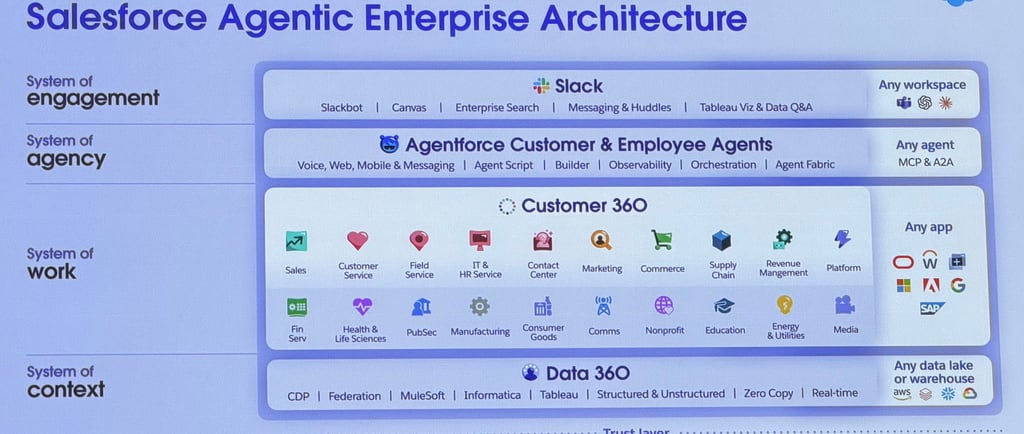
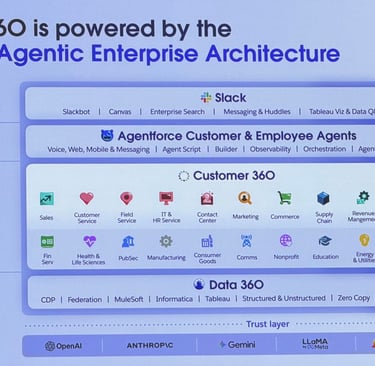
The enterprise software world is quietly undergoing a fundamental shift and Salesforce just made one of its boldest moves yet.
With the launch of Headless 360, Salesforce is no longer positioning itself as just a CRM platform. Instead, it’s transforming into infrastructure for AI agents—a move that could redefine how businesses interact with software altogether.
From UI-Driven CRM to Agent-Driven Infrastructure
For decades, enterprise software revolved around human interaction: dashboards, forms, and endless clicking. But that paradigm is starting to break.
AI agents—capable of reasoning, planning, and executing tasks—don’t need user interfaces. They operate through APIs, commands, and workflows. Salesforce’s answer to this shift is Headless 360: a platform where everything is accessible programmatically, without relying on traditional UI layers.
In simple terms:
👉 Instead of humans using Salesforce, AI agents can now “use” Salesforce directly.
This raises a provocative question already being discussed across the industry:
Do we even need traditional CRM interfaces anymore?
What Exactly Is Headless 360?
Headless 360 is not a single product—it’s a re-architecture of the entire Salesforce platform.
At its core, it exposes:
Data
Workflows
Business logic
Automation tools
…through APIs, Model Context Protocol (MCP), and command-line interfaces.
This means AI agents can:
Execute sales workflows
Resolve customer service cases
Trigger automations
Interact with enterprise systems
without ever opening a browser.
Salesforce has also introduced dozens of new tools and coding skills, giving agents deep, real-time access to enterprise systems.
Why This Matters: The Rise of the Agentic Enterprise
This launch is part of a bigger trend: the emergence of the agentic enterprise.
In this model:
Humans define goals
AI agents execute tasks
Platforms act as infrastructure
Salesforce is betting heavily that agents—not humans—will become the primary users of enterprise software.
This isn’t theoretical. The company has already seen AI agents handle significant portions of customer interactions and workflows in real-world scenarios.
Headless 360 accelerates that vision by removing the biggest bottleneck:
👉 Human-dependent interfaces
The Strategic Shift: From SaaS to “Agent-as-a-Service”
Traditionally, SaaS platforms like Salesforce monetized:
Seats (per user)
Licenses
UI-based workflows
But Headless 360 hints at a different future:
Consumption-based pricing
API-driven usage
Agent-executed transactions
In other words, Salesforce is evolving toward “Agent-as-a-Service” infrastructure.
This also aligns with broader industry pressure, where AI-native companies are challenging traditional SaaS models.
The Experience Layer: UI Isn’t Dead—It’s Optional
Interestingly, Salesforce isn’t eliminating interfaces altogether.
Instead, it introduces an experience layer that allows outputs to appear anywhere:
Slack
Voice assistants
Messaging platforms like WhatsApp
This decouples what gets done from how it’s presented.
So while agents do the work behind the scenes, humans still interact with results in familiar environments.
Competitive Implications
Salesforce’s move is not happening in isolation.
The broader AI ecosystem—from foundation model providers to developer platforms—is racing toward:
Multi-agent collaboration
Shared context between systems
Autonomous workflows
One of the biggest challenges today is that agents don’t “think together” effectively across systems.
By turning its platform into programmable infrastructure, Salesforce is positioning itself as:
👉 The central operating layer for enterprise AI agents
If successful, this could give it a significant lead over traditional SaaS competitors.
The Real Question: Are Enterprises Ready?
While the technology is compelling, adoption won’t be instant.
Enterprises will need to rethink:
Governance and control of AI agents
Security and trust layers
Monitoring and observability
Cost models tied to agent activity
Salesforce has introduced tools to manage agent behavior before and after deployment—but operational maturity will be the real test.
Final Thoughts
Headless 360 is more than a feature launch—it’s a philosophical shift.
Salesforce is essentially saying:
The future of enterprise software is not human-first. It’s agent-first.
If that vision plays out, we’re heading toward a world where:
Software becomes invisible
Interfaces become optional
AI agents become the primary workforce
And platforms like Salesforce evolve into the invisible infrastructure powering it all.